I found myself back on this blog, playing in the garden ... So if you're reading this even after my long absence, I thank you so for checking back in with me!
I thought I'd share some art with you. My mom and I have the same birthday (different years, of course!), so for her/our birthday, she and I and my younger daughter headed to the nearby rose garden to create art and experiment (if we wished) with haiku. My mom occasionally paints and draws, and she's also a writer, and a gardener, and a naturalist, so I thought it would be fun to share what we love all in one go!
Here's my daughter's art:
She captured a lot of detail about the rose plant itself:
Here's my mom's. She calls it "Perfect Scent":
And here's mine:
What fun we had!
Wednesday, December 1, 2010
Thursday, July 29, 2010
Deepening The Garden
Hello, dear Readers!
Earlier this year I pondered the fate of my blogs, having started a couple of new ones. Five seemed absurd! At the time I decided to continue this one -- I do like it here! But as the months progressed, I've discovered that much of what I enjoy posting about here actually has a voice in my new blogs -- or would, if I allowed this little field to leave my care and go feral :-). In trying to tend many blogs, I'm finding I'm not able to tend well to any (a predictable result!).
So ... If you enjoy posts that focus on herbs, being a mom, self-directed learning, rewilding, and wise village ways, please join me at Moms Create Culture. This blog is as much about my own personal journey as a mom attempting to create and nourish heart-centered culture starting with my own home and garden as much as intending to help moms create and deepened resilient, nature-and-soul-connected culture in their businesses and communities.
If you are more interested in plant spirit medicine, Reiki, sound healing, or music (harp and song), spiritual seeking, the magic of nature, and story ("inner tracking" or narrative medicine) you might want to check out my blog at Singing Deer Healing.
You'll find an intermingling of topics on both. I'm not going just write about herbs or wise village ways, or connecting with the nature of your place in just Moms Create Culture, for instance. But I intend to let you know in either blog when a post in the other might be of particular interest to you (assuming you don't want to subscribe to both blogs!).
Fox Tales is my third blog. This one is dedicated to what I call "magical nature story" -- my fiction, photo-stories, and perhaps other creative expressions for children and the child in you. I have a feeling this blog will evolve (as they all will, no doubt) but for now it features weekly installments of my children's novel-in-progress, Because Of The Red Fox.
So thank you for reading a harper's garden! I've certainly enjoyed tending this little garden, and have been honored by your company within it! I do hope to "see" you in the deepening garden of my creative expression and voice in one of my other "ecologies", or two, or in all three :-).
Earlier this year I pondered the fate of my blogs, having started a couple of new ones. Five seemed absurd! At the time I decided to continue this one -- I do like it here! But as the months progressed, I've discovered that much of what I enjoy posting about here actually has a voice in my new blogs -- or would, if I allowed this little field to leave my care and go feral :-). In trying to tend many blogs, I'm finding I'm not able to tend well to any (a predictable result!).
So ... If you enjoy posts that focus on herbs, being a mom, self-directed learning, rewilding, and wise village ways, please join me at Moms Create Culture. This blog is as much about my own personal journey as a mom attempting to create and nourish heart-centered culture starting with my own home and garden as much as intending to help moms create and deepened resilient, nature-and-soul-connected culture in their businesses and communities.
If you are more interested in plant spirit medicine, Reiki, sound healing, or music (harp and song), spiritual seeking, the magic of nature, and story ("inner tracking" or narrative medicine) you might want to check out my blog at Singing Deer Healing.
You'll find an intermingling of topics on both. I'm not going just write about herbs or wise village ways, or connecting with the nature of your place in just Moms Create Culture, for instance. But I intend to let you know in either blog when a post in the other might be of particular interest to you (assuming you don't want to subscribe to both blogs!).
Fox Tales is my third blog. This one is dedicated to what I call "magical nature story" -- my fiction, photo-stories, and perhaps other creative expressions for children and the child in you. I have a feeling this blog will evolve (as they all will, no doubt) but for now it features weekly installments of my children's novel-in-progress, Because Of The Red Fox.
So thank you for reading a harper's garden! I've certainly enjoyed tending this little garden, and have been honored by your company within it! I do hope to "see" you in the deepening garden of my creative expression and voice in one of my other "ecologies", or two, or in all three :-).
Friday, June 25, 2010
Honoring Song To Oats (Avena sativa)
Please join me in the garden! Here I offer an honoring song (improvised in the moment to the Oats (Avena sativa) as I harvest oat tops to make a tincture.
Monday, May 31, 2010
Chickens: Alas, Poor Bluestar + Kooshie the Amazing
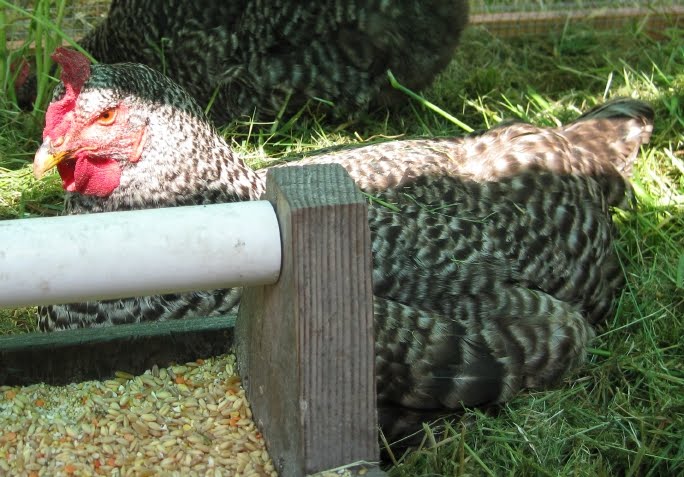
We received word this morning that Bluestar, one of our Black Gourmet (a meat breed) hens had passed away. Tears didn't accompany this news, because in a large way this hen has lived longer than we ever guessed she would. A couple of years ago Bluestar developed bumblefoot, which, though we tried in various ways to heal, just got steadily worse. She ended up limping about on one foot, resembling (to our fanciful minds) a "dufflepud" from The Voyage Of The Dawn Treader (in the Narnia Chronicles) by C. S. Lewis.She survived the long cold winter in NE Oregon (even when Cheeseball, her companion on the ground floor of the hen house, passed away). And she continued on, limping about, and huddling near the feeder for the next year.
The above photo is from a year ago.
Few tears doesn't mean that we're not sorry that she's gone. With each passing of our hens in far off Washington, we wish we could bring them close again, but it really wouldn't have worked out to have these large birds in our somewhat small suburban backyard!
Bluestar was my younger daughter's favorite hen when we first got our flock. A young Gwynne would scoop this (then) large bird up and cart her around the yard.
(a sigh as I type for days of yore)
On the other hand, Kooshie's story is that of a miracle. Several weeks ago, our friend who is caring for our "big girls" in Washington, phoned to tell us that one of the Easter Eggers had gotten caught in the electric fence. Who knew how long she'd been caught, but she was all tangled up, and had to be cut out. Our friend brought Kooshie inside, and placed her under a heat lamp, and wrapped her up. Kooshie was alive but wouldn't move or open her eyes, and we all feared the worst about her. I sent Reiki, and beseached my plant allies for help on Kooshie's behalf. Many tears indeed were shed, as Kooshie is my older's daughter's hen, and is quite a sparkling personality (she flies to her arm).
Later that day our friend called to say that Kooshie had opened her eyes, and drunk a little water. A report the next day was that she was standing up, and had eaten. Within a few days she was back with her flock, fully recovered. Even as our friend reported Bluestar's death this morning, she also told us that Kooshie was still perfectly well. It was as if her trauma had never happened.
Our life with chickens is such a microcosm of life and death and trials and celebrations. I'm in such gratitude for these serious and silly birds, for the love they have awoken in my daughters, in our family, and how they teach us about both the fragility and resilience of life.
Kooshie - a photo from our visit to Vashon last Dec.
Saturday, May 29, 2010
Children's Art and Chickens
I have a backlog of posts on things herbal for this blog, but thought I'd share with you some art I scanned today (they are garden related!).
I love the art children create. On Vashon Island, our former home and home-to-be-again, first Fridays of the month are celebrated as First Friday Art Walks. On these Fridays, art galleries and shops and cafes showcasing local artists present new displays of art. You get to meet the artist, enjoy yummy snacks, chat with fellow viewers, and enjoy fabulous and fun art by folks you know and folks you don't. When our family was part of a homeschool co-op, I thought it would be a cool idea to feature our children's art in one of our homes and include it in the art walk. The art could rotate each month, featuring new artwork by the children.
Well, I never saw this vision to fruition, though in our own home for a time I made sure to showcase our girls' artwork in frames and rotate the artwork. Even now I prefer to display artwork we create, rather than buying that of professionals (unless I know and love them!). I love the freshness of children's art!
These paintings are by Gwynne from a number of months back, of a rooster (above) and of Amri's rooster, Lord Firestar (to the left).
And since we're on the subject of chickens, I'll include a photo of Lord Firestar with the first bloom of the season of our Mr. Lincoln rose. Aren't they both handsome?
Enjoy!
I love the art children create. On Vashon Island, our former home and home-to-be-again, first Fridays of the month are celebrated as First Friday Art Walks. On these Fridays, art galleries and shops and cafes showcasing local artists present new displays of art. You get to meet the artist, enjoy yummy snacks, chat with fellow viewers, and enjoy fabulous and fun art by folks you know and folks you don't. When our family was part of a homeschool co-op, I thought it would be a cool idea to feature our children's art in one of our homes and include it in the art walk. The art could rotate each month, featuring new artwork by the children.
Well, I never saw this vision to fruition, though in our own home for a time I made sure to showcase our girls' artwork in frames and rotate the artwork. Even now I prefer to display artwork we create, rather than buying that of professionals (unless I know and love them!). I love the freshness of children's art!
These paintings are by Gwynne from a number of months back, of a rooster (above) and of Amri's rooster, Lord Firestar (to the left).
And since we're on the subject of chickens, I'll include a photo of Lord Firestar with the first bloom of the season of our Mr. Lincoln rose. Aren't they both handsome?
Enjoy!
Tuesday, April 13, 2010
From the Ground Up: Grassroots Training in Traditional Western Herbalism
I've been looking forward to this five-part course for ages. The concepts of Traditional Western Herbalism have fascinated me, and I've spent many an evening musing over Matthew Wood's books expressing herbal medicine from this perspective. To me, the ideas expressed in this tradition offer a fascinating and potentially very effective compass of perceptions to glimpsing and stepping into the unique ecology of one's family members, friends, or clients in a respectful, receptive manner, and from that place, offering herbs more attuned to that person and his or her condition. That's my take on all this! We'll see what my journey with the herbs from this perspective leads me! - Jane
From the Ground Up: Grassroots Training in Traditional Western Herbalism
by Jesse Wolf Hardin on April 13th, 2010
COURSE 1
of a 5 course program for the village herbalist: From the Ground Up: Grassroots Training in Traditional Western Herbalism
FOUNDATIONS IN TRADITIONAL WESTERN HERBALISM
Written & Taught by Kiva Rose Hardin
.
.
Lessons arrive as PDF files, with beautiful, illustrative color photos scattered throughout.
To register, go to the bottom of this post and click on the Application link.
The Course Work
Each lesson consists of a core topic, accompanying definitions and terms, a section on Materia Medica with an in-depth profile of a single herbal ally, and another featuring a description and complete directions for foundational medicine making techniques, with questions and assignments for every section. Course 1 includes 4 lessons:
- Lesson 1: The Roots of Traditional Western Herbalism
Materia Medica: Nettles (Urtica spp.)
Medicine Making: Tisanes, Infusions & Nourishing Infusions - Lesson 2: Healing as Wholeness & The Tonic Approach
Materia Medica: Mullein (Verbascum spp.)
Medicine Making: Infused Oil - Lesson 3: Vitalist Herbalism & The Anima
Materia Medica: Evening Primrose (Oenothera spp)
Medicine Making: Decoctions - Lesson 4: The Matrix – Healing & the Material World
Materia Medica: Goldenrod (Solidago spp.)
Medicine Making: Herbal Baths & Hydrotherapy
Once your Foundations in Traditional Western Herbalism questions and assignments are complete, you may then want to enroll in each of the following, soon to available courses:
- Course 2: Elements in Energetic Herbalism
- Course 3: Human Ecology: Physiology & Organ System Energetics for the
Traditional Herbalist - Course 4: Reading the Terrain: Practical Diagnostics for the Traditional Herbalist
- Course 5: Restoration: Pathophysiology & Diagnostics for the Traditional Herbalist
About Your Instructor
Kiva writes: “My focus is firmly on accessible, grassroots herbalism that educates the individual and serves the community, both the human component as well as the larger earthen community. I strongly believe in restoring health at all levels and approach healing from the understanding that the body is a diverse and intelligent ecology, integrally connected to the planet as a whole.”
As her partner in this life and work, I couldn’t be more proud of her efforts, or more impressed with this life-empowering and life-enhancing course.
Donations
All courses are offered on a donations basis, with a $200 to $400 suggested sliding scale depending on your ability to contribute and how much you value what is offered. Those unable to donate the complete amount at once, are invited to contribute over time as able.
Apply Now
To apply, click on the link below, then download, fill out and return the:
And please make the time to spread the word about this exciting series of courses, by pasting and forwarding this message to your mailing list, or reposting this announcement on your blog or in appropriate forums you frequent. Thank you for your patience in waiting for this course to be released, and for your commitment to healing, the plant world and this School.
-Jesse Wolf Hardin
Wednesday, February 17, 2010
The Healing Grace of California Poppy
Below is my final assignment for Angie Goodloe's Herbalist 101 course. Be warned, it's lengthy! But there's a surprise at the end. If you have any interest in herbalism, I highly recommend Angie's course. It's full of information, provides plenty of opportunity for you to get intimate with herbs and make those medicines. And Angie provides plenty of feedback and encouragement in her responses to the assignments. Fun stuff!
Also, Angie is currently offering the course at an absurdly low price ($35!). I assure you, the course is worth far, far more than that!
California Poppy (Eschscholzia californica)
Alternate names: Copa de ora, Dormidera (the Drowsy One, since this 'sun-worshipping flower' closes its blooms at night)
Family: Papaveraceae
Patterns of the Poppy family are showy flowers with 2-3 sepals that shed early, petals in multiples of four, lots of stamens. They often have milky sap in their stems. Many plants in this family contain narcotic alkaloids. Narcotics depress the central nervous system, sedating and offering relief from the feeling of pain (analgesic). [I'm noting Family characteristics in anticipation of work I'm doing with the Kamana Naturalist Training Program. Currently in that program I'm journaling Plants, which will soon include detailing all the native plant families of my area.]
With that "Family background" in mind, let's explore this beautiful herb ...
The state flower of California, California Poppy is aptly chosen for this honor. For countless generations the native peoples of California carefully cultivated this plant--as they did with many others--for food and medicine in monocropped expanses on hillside and in valleys. European settlers thought they had arrived in untouched wilderness. Not so. The native peoples practiced sustainable harvesting and sowing that involved controlled burns as part of their land management.
It is said that north of Pasadena early Spanish sailors guided by a golden hillside in spring -- a hillside shining with the bright orange-gold of the California Poppy. It is also said that this was one reason they dubbed this coast "the Land of Fire" (the other reason being that there were indeed fires a-plenty due to lightning strikes as well as due to the dry, arid summers).The Yuki tribe used it for toothaches, it was food for the Sierra Miwoks, the Ohlone used it for sleep, the Wintu used it to heal newborn baby belly buttons
The Nisenan ate the leaves either boiled or roasted with hot stones and then laid in water. The Pomo mashed the seedpod or a decoction of it on a nursing mother's breast to dry up her milk. And the plant was given to babies as a sedative and placed under the bed for better sleep. Other tribes rubbed a decoction of the flowers into the hair to kill lice. The root juice was taken to relieve stomachaches and tuberculosis, and as a wash for weeping sores.
The plant itself: is a perennial or annual (further north) to 2 ft. tall with mostly basal with bluish-green lacelike leaves. When I lived in the Pacific Northwest, the plant was an annual. Here in my backyard in the San Francisco Bay Area, the plant is definitely a perennial. The plant in these photographs is one that has been thriving since our arrival here last June.
The flowers sit atop a flattened rim on long stalks. The flowers are of four shiny petals bright orange to yellow in color, sepals fused into cap, and falling off when it flowers. Many stamens. The fruit is long and slender, containing many black seeds. It's so satisfying to collect the seeds! Just pluck off the dried pods and pop them into an envelope. The plant flowers from February through November.
The plant is found in grasslands, hillsides, and open areas, in well-drained and poor soil, from Southern California up through Washington.
In terms of modern-day herbalism California Poppy has these characteristics.
Taste: Bitter
Energy: Cool
Organs affected: Liver, Heart
Actions (according to Lesley Tierra): calm the Spirit (I most definitely agree!)
Properties: Sedative, analgesic, anti-diarrheal, antitussove. diaphoretic, antispasmodic
Indications: anxiety, nervous tension, agitation, neuralgia, pain relief (including acute), nervousness, sciatica, herbes, shingles, heart palpitations, insomnia
Dose: rounded teaspoon of chopped plant as tea, drink 1-3 times daily; fresh plant tincture: 20-60 drops 1-4 times daily. For sleep problems, take 20-40 drops one hour before sleep, then again right before bedtime. For bedwetting in children over 5 years old, use with horsetail, 10 drops of each twice/day.
A mild sedative and analgesic, this plant is suitable even for children, though may cause a mild 'hangover' headache the next morning if used in excessive quantities. Lesley Tierra writes: "California poppy wonderfully sedates, calms and relaxes the nervous system, treating symptoms of anxiety, nervous tension and agitation. As well, it repairs nerves and alleviates nerve pain, especially from sciatica, herpes and shingles. It is also used for heart palpitations and insomnia due to nervousness.
Contraindications: large amounts used sometimes cause nausia. Better not to use it during pregnancy.
Collecting: Gather the whole above ground plant and dry it. Or tincture the whole fresh plant. When I tinctured California Poppy in the past, I used the whole plant, including the roots.
My Own Experience With California Poppy:
Moving to the Pacific Northwest 12 years ago (from the SF Bay Area) I was overjoyed to discover that California Poppy lived up there. For me, California Poppy has always represented the spirit qualities of joyfulness and home. My spirits lift at the sight of this plant in bloom, and I marvel at the softness and lacy beauty of the leaves. But this plant is no fragile beauty. There is a boisterousness of spirit that seems to me to announce itself in celebration to the world at large -- to the bees and insects, the natural world, and definitely to us humans! As plant spirit medicine I have turned to California Poppy whenever I have sought a sense of 'home' within my anxious heart, and the promise of a lively grace that can exist and persist even in the face of inevitable hardships and pain. I'll sit with the plant, touch its velvety petals or soft foliage, or nibble its leaves or petals. Just being with this plant opens something true, kind, and strong within me.
More along these lines: When I became a Reiki Master, I intuitively received a series of symbols -- conduits for particular healing energy. One of them I have come to associate with California Poppy, and this I use in spirit healing whenever I feel that California Poppy's qualities are needed.
A few years ago, my friend Lisa and I gathered the whole plant garden and tinctured it in vodka. The tincture rapidly became our favorite remedy for sleeplessness due to nervous tension. I believe Lisa used it with her family successfully to ease tooth pain. Certainly I would use it for that purpose! It is my remedy of choice when nervous anxiety is mixed with a need for (physical) pain relief.
Last year, during our family's transition, I felt my mind returning to nervous anxiety that began again to interfere with my sleep. The previous year I'd had a long stretch of this, and it was certainly hard to function coherently and in a grounded way at that time! I pulled out my California Poppy tincture and began to take it at bedtime. Just a couple nights of this routine and I was able to resume a more restful sleep pattern.
Here in early spring, new poppy plants are emerging in our vegetable garden. The sturdy plant in the photos and in the video below, continues to thrive. We are astonished by this particular plant, as it was accidently stepped on when we were digging our garden last year. Somehow -- perhaps because of the love and attention my daughters have lavished upon it since then -- it recovered and has become the bold beauty of the garden.
Below is a video of the California Poppy. In it, I listen for a 'medicine song' and infuse it with Reiki. As you listen to the song, may you experience the healing qualities of this plant!
Resources:
Thomas Elpel, Botany In A Day
M. Kat Anderson, Tending The Wild: Native American Knowledge And The Management Of California's Natural Resources
Steven Foster and Christopher Hobbs, Western Medicinal Plants And Herbs (Peterson Field Guide)
Herbalpedia 2007
Lesley Tierra, Healing With The Herbs Of Life
Michael Moore, Medicinal Plants Of The Mountain West
Matthew Wood, The Earthwise Herbal: A Complete Guide To New World Medicinal Plants.
Art by me of California Poppy (with Plantain and grasses in the foreground)
Labels:
California Poppy,
herbal courses,
herbs,
plant spirit medicine,
Reiki
Friday, January 22, 2010
Time - for the Sketchbook Project
Recently I participated in The Art House Co-op's Sketchbook Project. They assigned me the topic of Time, and I set to work. Quickly I realized I was "running out of time". First one daughter, then the other, jumped in to help me, and the project became a mother-daughters affair. My younger daughter contributed a lot of artwork, and my older daughter took a few photos.
Some of it was probably not what the visioners' had in mind: I ended up printing out copies of some of my past art and photos to finish the book. In the end I sent it off -- on Time -- to The Art House. Whether they include it in their Tour (the idea is that these sketchbooks will be a library collection, going on tour and then eventually housed in a library), and then enter a permanent collection or not, it certainly ended up being great fun creating a project like this with my daughters. My younger daughter was especially determined that we finish it--no cutting out pages to do so!
Anyway, here it is. Enjoy!
Some of it was probably not what the visioners' had in mind: I ended up printing out copies of some of my past art and photos to finish the book. In the end I sent it off -- on Time -- to The Art House. Whether they include it in their Tour (the idea is that these sketchbooks will be a library collection, going on tour and then eventually housed in a library), and then enter a permanent collection or not, it certainly ended up being great fun creating a project like this with my daughters. My younger daughter was especially determined that we finish it--no cutting out pages to do so!
Anyway, here it is. Enjoy!
Saturday, January 16, 2010
Checking In, You, and Lavender Wand Recipe

Corn in our backyard -- in December! Art by Jane
It's been quite some time since I've posted! Thank you for sticking with me!.
Just to let you know what's up with me and my blogs. I've just started a new website and blog, Singing Deer Healing, which is devoted to sharing a soul-nourishing, imaginative, nature-connected life with children. If you like this blog, you may enjoy that one too.
After puzzling how to proceed (eep, how many blogs can I keep going?), I've decided to continue this one. It has become a focus for my chronicling my attempts to live a 'magic' life with my own children and my herbal medicine making journey. ... And I feel restful in this space :-). I don't know how often I will write this blog ... it's probably going to follow a slower gait than, say, Singing Deer Healing or Jane's Medicine Tree (or a possible fourth blog I have in mind centered on moms and culture), but I'm pretty sure I'll post once or twice a month. So if that works for you, I invite you to continue reading!
You
This is a great time for me to get to know you. What do you love in life? What is the greatest challenge for you right now? What have you enjoyed in this blog? Perhaps I'll just boldly ask "Why are you here?" :-).
What is your greatest wish for the planet? For your home life?
If you had one message you could deliver to the world that would be truly heard and tended to, what would you say?
Please jot your thoughts in the Comments below. I'm so delighted and honored that you're here!
Lavender Wand Recipe
Awhile back Lauren asked for cooking times and temps for this recipe. Okay, Lauren, here's the whole recipe--finally! It uses lots and lots of sugar. I wonder if it's possible to vary the recipe successfully using honey? Something for me to experiment with in the future ... Anyway, here's the recipe.
Preheat oven to 150 F degrees.
In a pan, bring 2 cups of sugar and 1 cup of water to a boil. Take 30 wands of lavender (do not remove from stem) and place the buds in the boiling sugar water leaving the stems out of the pan. Reduce heat to medium high, and let boil for 10 min.
Put a thin layer of sugar onto a cookie sheet, to cover the entire sheet
Remove the wands from the sugar water (you can keep the sugar water to use in some other delicious way!) and place them on the sugared cookie sheet. Spread the wands in a single layer.
Pour 1 cup of sugar evenly over the wands (yeah, this recipe uses tons of sugar!). Let set for 2 min. Turn wands over and sugar again.
Take another cookie sheet, and place the sugared wands on it in a single layer. (save the sugar from the other cookie sheet and when it's cool, store it in a jar in the fridge to have lavender sugar on hand for baking, etc.)
Bake the wands for 30 minutes.
Remove from oven and cool.
Enjoy! Kids--and the kids in us--just love these enchanted treats!
Sunday, November 1, 2009
Day Of The Dead
It is November 1, and the veil between the worlds is oh-so-thin. I currently live in the house that my grandparents had built in 1936, and in which they lived all their lives. I light a candle by the photo of my grandmother as a young woman, and go about here doing as she did in this house day after day: preparing food, sweeping, hanging clothes outside to dry or downstairs in the basement warmed by Mary Ann, the huge old heater that reminds me of her namesake Mary Ann the steam shovel the picture book Mike Mulligan And His Steam Shovel, who ended up becoming the heater for the new town hall. The full-page magazine photo of Pres. JFK and his beautiful wife Jackie no longer graces the wall on the basement staircase. And much of the furniture that served my grandparents for 60 or 70 years has been replaced by ours. Still. The gentle spirit of mis abuelitos continue here, walking the floors, tending the roses. When I prepare food, I create a special plate for them ~ and for all mis abuelos from throughout time. I place it at the base of the huge medicine tree in the backyard, the incense-cedar. I offer prayers and thanksgiving, and open my senses to the boundless nature of our expansive universe, and to the delicate markings of jeweled thyme.
Monday, October 12, 2009
Garden, Tincture Disaster, and Willow
Goodness, it's been much too long since I've posted here! Our pocket garden out back is doing beautifully, as you can see here. We may never see the corn actually mature enough to produce ears, but I am getting enough Asian greens to create small salads every day.
Rosemary and Lemon Balm are doing well in pots, as is Spearmint. I love to take nibbles of the leaves as I pass by!
After collecting a small jar full I poured them out and chopped them up.
During the first few days I was pretty good about shaking the mixture. Unfortunately I totally forgot about this project. Checking it today, I realized I'd overfilled the jar with the haws. They perched above the kirsch-line, and look pretty disgusting. I don't think I dare give it a taste!
Ah well. Live and learn!
Rosemary and Lemon Balm are doing well in pots, as is Spearmint. I love to take nibbles of the leaves as I pass by!
Hawthorn Tincture
At the end of August I plucked the lovely haws from our old hawthorn tree.After collecting a small jar full I poured them out and chopped them up.
Back into the jar, which I then filled with kirsch.
Megan, Lila, and the horses gaze at the red mush thingamy, just after it's prepared.
During the first few days I was pretty good about shaking the mixture. Unfortunately I totally forgot about this project. Checking it today, I realized I'd overfilled the jar with the haws. They perched above the kirsch-line, and look pretty disgusting. I don't think I dare give it a taste!
Ah well. Live and learn!
Pacific Willow
At 4-H yesterday, we visited a rabbit breeder in the area. The rabbits were so very lovely and cute (I will not often describe anything in print as "cute",but I'll make an exception here!), as you can see if you visit Plain Old Chickens. But during our visit I continually felt tugged in another direction. Alongside a gorgeous swimming pool were a series of graceful towering trees.
After studying them for a bit, I realized why I was so drawn to them. The ridge-y bark, the drape of leaves--and even more, the feel of the trees themselves. I knew them! They are Pacific Willow, the tree I sat at back in Joseph, Oregon last year in the depths of winter. This was the tree that served as the image of my "medicine tree" on my blog Jane's Medicine Tree until a few days ago. Realizing this, I just soaked in the energy of the trees -- their rooted presence, the clear mind essence (such as Lemon Balm offers), their gently magnificent grace (a very different feel from Lemon Balm!).
I'm not sure I've ever energetically noticed the particular presence of a tree before, at least not consciously. I'm in awe!
My "medicine tree" back in Joseph, Oregon
Wednesday, August 19, 2009
Apple Farm School And Restoring A Garden
A thoughtful Lord Firestar in the gardenWithout me deliberately intending to get back in full-groove homeschooling (it is after all, only mid-August!), the rhythm of Apple Farm School (how we are registered in California) is well underway.
Constant to our daily life (homeschooling or not) is hours spent outside with our chickens and plants. Here in the suburbs that means our backyard. We're blessed to have a mature garden, with diverse shrubs, trees, and herbs in this small space, which attracts some lively wildlife: the shy gray-brown towhees scrabbling in the leaf-litter, hummingbirds, squirrels, the bold and brash raccoons, a little woodpecker whose name I have yet to learn, jays, crows. This morning I even heard the raspy sounds of Raven somewhere in the neighborhood. It's not total asphalt and buildings around here!
In our backyard, I read aloud each day. Gradually this summer, our reading time has been preceded by work on penmanship. We work with the Italic Manuscript Series, a system that offers a graceful, clear printing style that morphs gently into its cursive version. We don't have to learn a whole new style when learning cursive. We all work on our own books: my younger daughter with the first in the series, my older daughter and me on the last of the series (suitable for adults).
Our outdoor reading is currently the children's classic, The Secret Garden by Frances H. Burnett. We all love it -- delighting in the impassioned characters (the tantrums are a big hit), the magic of the garden as it transforms and as it transforms the children ... there is so much to enjoy in this book. As a nature mentor, I appreciate the book all the more for its beautiful depiction of the how immersion in one's senses and in the natural world, and connecting with the natural world has everything to do with connecting with oneself and bringing us into a joyful, fullness of being that literally transforms the lives of those around us.
The magic within The Secret Garden led us to look at our own garden with renewed eyes. First we dug up the seeds we'd collected from our farm last year before we moved (way more than I'd remembered collecting!). We stuffed seeds into the spare corners of three large pots I already have going with stinging nettle, kale, calendula, lemon balm, rosemary, raspberry, spearmint, chives. To all these, we've add bantam corn (!), sunflowers (!), California and Shirley poppies, and who knows what all. The girls love to plant seeds. It was at this point we determined it was time to restore some of the garden so that we could actually dig the soil and plant there -- theoretically a better location for a number of the seeds we'd shoved into those pots.
Well, the ground is solid hardpan clay. No topsoil. I don't know how the plants that are here actually thrive, because the soil is awful. So we've been banging away at a patch of ground with a hoe and shovel, spraying the dusty earth with water (and then spraying ourselves and have a general great time with water), and adding some compost. In two days, the patch (about 5' x 5') looks a lot more inviting, but not yet yummy enough or deeply enriched enough in which to plant. I need to feel as if I was gazing at and plunging my hands into a pan of the most delicious chocolate cake batter!
Okay, so that's the beginning of our garden. Our homeschooling, to me, is grounded first and foremost in a healthy lively family rhythm, complete with working with and tending to the things that nourish us. That includes shared household tasks, planning nourishing meals, growing our own food and herbs when we can, or at least using well good veggies and herbs that we find. In the food realm, I'm finally back in stride with this, having the girls help me plan meals for the week (and prepare them, of course). This week, we've been using Molly Katzen's Honest Pretzels for inspiration.
Smoothie Digresssion: Yesterday I concocted my favorite smoothie to date. First, I made a decoction of burdock root, dried elder berries, a little allspice, cloves, and orange peel. Then we blended strawberries, blueberries, whole milk vanilla yogurt, banana, and cinnamon. We added the decoction as the liquid. Yummy! Healthful too.
Back to homeschooling:
Our homeschooling has been different each year. In past years when the girls attended a lovely children's program two or three days a week, our style was mostly unschooling. In the past few years -- especially as we've been in transition -- we've shifted to a relaxed homeschooling approach. I find that having a more overt homeschooling lends our lives a beneficial rhythm and a purposeful nature, especially since we don't have a farm right now, or other regularly scheduled activities (classes, group activities, etc.). Unschooling-to-relaxed homeschooling worked very well for us on Vashon Island, when we were in the midst of a very active community and farm life. In our transitional state (the months preceding our move off the island, our ten months in Oregon, our temporary home here in California) working more overtly on subjects (rather than "coyote mentoring" with them as they come up naturally in our work and play in our days/weeks) helps stitch our days together in a pleasant way.
Having ordered the Second Grade Curriculum from Christopherus (Waldorf-inspired homeschooling resources) for my younger daughter, I've dug out our First Grade Curriculum, and have launched into the final lessons blocks of the book. Last spring, Andy had taken on up homeschooling the girls, using resources that appeal to his style and nature: The McGuffey's Eclectic Readers, and some Mathematics and Grammar books, also from that era (19th century). That certainly works great for him and the girls. I have a different style -- and the imaginative, artistic, holistic perspective of Waldorf (especially via Christopherus) works very well for me when I work with Gwynne.
My older daughter, being 15, is in a different sphere. Here what she and I do is discussion and reading at the center, and moving out from there. She directs a lot of her own learning. Anyone who has doubts about unschooling can have those doubts assuaged by seeing teen unschooling in action! My daughter has fully-developed passions and interests which have led her to all kinds of in-depth learning in an array of areas: biology, animal husbandry, writing, math, electronics, .... What Andy and I do with our daughter is support her passions (and offer our own skills/knowledge in relationship to those interests) and offer "unit studies" (we don't call them that -- but other homeschoolers would) on different topics we think she might do well to have in her knowledge-and-experience tool-kit, or that we just think are fun and cool :-). As a former English major I find literature to be cool and fun, so from The Secret Garden, we'll move into reading Rebecca by Daphne Du Maurier and Charlotte Bronte's Jane Eyre (I'm intrigued by similar motifs in all three of these books!). From there, we might move on to a unit study of Comedy & Tragedy ... Or perhaps Jane Eyre will inspire an excursion into a different realm ....
I've had a number of parents of young children talk to me recently about homeschooling, and what I can say here is that homeschooling can be very idiosyncratic! It can look and feel quite different from family to family, reflecting the values, passions, and style of each family. I call what we do "homeschooling", but honestly, love of learning, self-directed learning, and sharing our learning is so much a part of who we are as a family that I almost don't regard "homeschooling" as a separate subject in our lives (i.e., what we do instead of school). If anything, I use the term "homeschooling" as a marker: designating particular sorts of foci in particular points in a day, just like we have meal-times, or chicken time or clean up or chore time (or time on the computer!). Learning, of course, takes place anytime (okay, I couldn't resist writing something so corny & cheesy :-)!!!).
Thursday, August 13, 2009
Simpling My Life

Listening to the last audio in HerbMentor.com's Think Like An Herbalist course taught by Heather Nic an Fhleisdeir, I was struck by the notion that the whole thrust of my life in the past few years has been an attempt at creating a Simple. What's a Simple? Creating a medicine (be it an infusion, tincture, what have you) using a single herb. That sounds simple, but actually, a great deal can go into the process of choosing that one herb. You might (as Heather suggests) indulge in creating a list of gripes and complaints about your health, then list all the herbs you have available that would assuage those complaints, then circle three herbs that resolve the most complaints on the list. Then see which herb of which you have an abundance. You might choose that one herb as your Simple, because there are no coincidences. If you have an abundance of it, it may be a kind of "pick me, pick me!" or a "calm waiting for you to notice". (this is my interpretation of Heather's words!). Anyway, choosing a Simple is a personal and individual process. Two people with lists of similar complaints are likely to choose two different herbs as their Simple.
Okay, so I'm going about with my list in a mixed-up way. One thing I notice is the abundance of Rose in my garden, and in my jars (vinegar, tincture, dried ...). Notice, too, this bread which I made recently:

I used hand-ground spelt ...
And added rose petals and a bit of lavender from the garden, and some dried calendula and dried nettles.Okay, the mix of herbs is not "simple" -- but I'd have to say, that if any herb speaks as a Simple in my life right now, it would have to be Rose.
So, my thought is: okay, backwards is fine. How about listing my complaints now, and then researching Rose absolutely thoroughly. With which systems of the body does Rose work her magic? What, where, when, why, how does she work? Is there something about Rose that might soothe my achy wrists and shoulder? (too much typing) I've never heard/read of Rose working in this way, but what if certain qualities of Rose might be just what I need -- a Rose salve for instance? The Rose might inspire me to -- ah, slow down and smell the roses (so I spend less time on the computer, and less time furiously pecking away at the keyboard). But some aspects might be particularly soothing and healing to my body in other ways ....
A trail of thought, reflection, research, and experience to follow ....
Anyway, back to the idea of "Simpling my Life". I realize that actually a huge amount of reflection, experience, research, living is bundled up into a Simple, and there lies its potency -- because the herb is just right, just what you need, the perfect ally. In the past years of shedding many possessions, sifting through my passions, moving home a few times, it has been about finding the one place, the one expression of art and purpose that bundles all-that-I-am, that nourishes my entire system, and allows me to offer my self in my most potent fashion. How far do I carry the metaphor of Simple? The answer: as far as is useful. In the end it's an intriguing exercise of thought, and perhaps practice. I might do well to attend as well to the art of creating effective Formulas (using a few herbs together), and see what light this shines on who, what, how, why, I can live my most soulful, purposeful life.

Tuesday, August 11, 2009
Lovely Pres. Lincoln, Salve, and More
Here's a President Lincoln rose. Lovely, yes?Today I checked on my various rose mixes. My rose petal vinegar has a delightful bouquet. My rose petals tinctured in kirsch smell yummy. My yarrow tinctured in vodka has an intriguing spicey smell (in a good way). My cottonwood buds collected this past spring in olive oil have an, um, unusual smell. Not rancid, but ... I screw the lid back on and shove the jar back into the pantry, to inspect again later. Perhaps the trees I'd collected these buds from hadn't been Black Cottonwood ... Hm.
On the other hand: I open the jar containing my Black Cottonwood buds in olive oil, collected on Vashon Island in 2007. Wow, luscious. The buds have been there for two years! I take a small jar, shave some beeswax, filling the jar a quarter way. Then I pour the beeswax into a sauce pan, and gently melt the wax I pour some of the Black Cottonwood oil through cheese cloth, filling the jar 3/4s of the way, then add the filtered oil to the melted beeswax. After mixing it, I turn off the heat, pop a spoon into the mix, then put the spoonful into the freezer and leave it for a few minutes. When I check the consistency of the salve, I find it is just right. Hurrah! Last time I made Black Cottonwood salve (a couple of years ago), I'd added too much beeswax.
Back to the saucepan. I turn on the heat enough to warm the salve some more, and melt the salve from the spoon. Pour the salve into the jar. The salve now sits on the counter til it cools completely, then I'll screw on the lid and stash it away. I've tried some of the salve, and boy does it have a warm, delicious feel. And the scent -- mmmm!! My Balm Of Gilead salve is a success!
Tuesday, July 21, 2009
Acquainting Myself With Yarrow
I'm folding the ladder to shuffle to a new place in the yard, from which to reach for enticing plums. OUCH!!! I pinch my finger in the metal supports as they accordion closed.
Yuck. First something like a blood blister appears, then blood begins to ooze. I don't have plantain in my yard. Maybe it's a good time to make friends with Yarrow -- Achillea millefolium -- a plant I encountered in abundance on our camping trip in the Sierras last week, and which I'm studying in Herbalist 101.
Though I'd been more familiar with Yarrow's use to promote a sweat to encourage colds and fevers to move out of one's body, I'd recently discovered that among its many uses is to staunch internal and external bloodflow (in fact, some alternate names for Yarrow are, significantly, Blood Wort, Staunch Weed, and Nosebleed -- I love that one!) Yarrow also has anti-bacterial and anti-microbial properties -- nice for just cleaning a wound.
Okay! So how might I use Yarrow on my little wound? If it was growing in my yard, I'd probably pick some, chew it up, and place it against my skin, just as I do with Plantain ("nature's bandage"). Instead, I decide to brew a tea from the dried herbs I have in my pantry.
First, I sniff the dried flowers. Intriguing! Reminds me a little of Alfredo Sauce. A strange association! I brew a strong tea. In 10 minutes I swab my wound with the tea. Boy, that sure cleaned it up -- and look, Ma, no more flowing blood! Did it really act that fast, or had the bleeding stopped or nearly stopped already? I could cut myself again to find out, but that seems rather a grim action to take in the name of science!
Now, I drink. Well, it's rather nice, in a bitter, dandelionish way. The inside of my mouth begins to go dry. Okay, so it has astringent properties. I'm still a bit mixed up about plant energetics, but I am so reminded of dandelion root, I might venture to guess that Yarrow is "cooling". Except that Yarrow is used to promote sweats. That suggests "warming" at the very least. Well, I'm still mixed up for sure here! And what about the feel ... hm. (sip, swallow) Not downward or "sinking". If anything it's "outward" and upward. Floating energy?
Okay, enough fussing on semantics. I pick up my newest favorite book, The Book Of Herbal Wisdom by Matthew Wood. I lose myself in his discourse on Yarrow. Holeee!!!! What an incredible herb! Definitely good for treating deep wounds, it seems, and blood blisters. Not only that, but there is some great information about using Yarrow sitz baths for curing uterine fibroids and Yarrow tea for easing excessive menstrual flow. These aren't problems I have, but two women close to me do. I'll have to pass on the information to them, and see what they think (checking in with them too to see that they aren't allergic to members of the daisy family!). My heart quickens just a bit. I feel like this time I really have information regarding a particular herb
that feels right for their issues, quietly potent, and harmonious with each of them in different ways. Is there something else I should consider here?
My experience of Yarrow: This lovely feathery leafed plant (Matthew Wood describes the feathery leaf as being single leaves evolved to just the ribs or vein, literally "cut to the bone and the artery") with its umbrels of tiny white flowers flourished in that open high altitude meadow near our campsite. I recall it growing on our open hillside back on Plain Old Farm in our former Vashon Island home. I can't wait to meet up with Yarrow again, now that I'm getting to know her better!
Tincture!
So, I'd love to make a tincture of Yarrow. Usually I prefer to work with fresh plants, but lacking a population of Yarrow in my yard, I pull the dried herb
back out from my cupboard. The ratio is 1:5, dried herb to 100 proof Vodka.
Browsing the web, I try to figure out what that means. Do I fill the jar 1/5th
full with the dried herb? Some places talk about particular weights .... In the
end I fill my jam jar almost halfway with the Yarrow, and pour 80 proof Vodka to the top. Since (several years ago) I purchased the Vodka specifically for tincture making, I wonder why I bought 80 proof and not 100 proof? Another browse through the web. Seems like 80 proof is just fine in some folks' dried herbal tincture making.
The little jar filled up lacks vitality to me. I call on Reiki and begin infusing the tincture with healing energy. As I do so, I connect with my memories and experiences with Yarrow, how that herb feels to me. I open to feeling the presence of Yarrow. The spirit of Yarrow is here, and perhaps Yarrow blesses my humble efforts. I offer Reiki to her in gratitude ....
Mullein Oil Update
Well, it turns out that two weeks apparently is long enough for cold-infusing the mullein (aka Verbascum thapsus) in olive oil. Mine has been infusing for five weeks! Opening the jar, I look at it carefully and take several deep sniffs. Smells fine. Nothing scary. I rummage through my cabinets, and can't locate my muslin. Rats. Okay, we'll see what I can do with coffee filters. Will the oil be too thick to pass through the filter?
I squeeze and smoosh it through once. Plenty of sediment. Probably it moved through a hole in the filter. So I pour it through a second filter and let it sit. Seems to be draining S-L-O-W-L-Y through. Okay! This will work, though perhaps coffee filters aren't the most efficient way to process an infused oil.
I relabel my jar, and stick it back into the cabinet. The mullein oil is now ready for use, if needed!
Yuck. First something like a blood blister appears, then blood begins to ooze. I don't have plantain in my yard. Maybe it's a good time to make friends with Yarrow -- Achillea millefolium -- a plant I encountered in abundance on our camping trip in the Sierras last week, and which I'm studying in Herbalist 101.
Though I'd been more familiar with Yarrow's use to promote a sweat to encourage colds and fevers to move out of one's body, I'd recently discovered that among its many uses is to staunch internal and external bloodflow (in fact, some alternate names for Yarrow are, significantly, Blood Wort, Staunch Weed, and Nosebleed -- I love that one!) Yarrow also has anti-bacterial and anti-microbial properties -- nice for just cleaning a wound.
Okay! So how might I use Yarrow on my little wound? If it was growing in my yard, I'd probably pick some, chew it up, and place it against my skin, just as I do with Plantain ("nature's bandage"). Instead, I decide to brew a tea from the dried herbs I have in my pantry.
First, I sniff the dried flowers. Intriguing! Reminds me a little of Alfredo Sauce. A strange association! I brew a strong tea. In 10 minutes I swab my wound with the tea. Boy, that sure cleaned it up -- and look, Ma, no more flowing blood! Did it really act that fast, or had the bleeding stopped or nearly stopped already? I could cut myself again to find out, but that seems rather a grim action to take in the name of science!
Now, I drink. Well, it's rather nice, in a bitter, dandelionish way. The inside of my mouth begins to go dry. Okay, so it has astringent properties. I'm still a bit mixed up about plant energetics, but I am so reminded of dandelion root, I might venture to guess that Yarrow is "cooling". Except that Yarrow is used to promote sweats. That suggests "warming" at the very least. Well, I'm still mixed up for sure here! And what about the feel ... hm. (sip, swallow) Not downward or "sinking". If anything it's "outward" and upward. Floating energy?
Okay, enough fussing on semantics. I pick up my newest favorite book, The Book Of Herbal Wisdom by Matthew Wood. I lose myself in his discourse on Yarrow. Holeee!!!! What an incredible herb! Definitely good for treating deep wounds, it seems, and blood blisters. Not only that, but there is some great information about using Yarrow sitz baths for curing uterine fibroids and Yarrow tea for easing excessive menstrual flow. These aren't problems I have, but two women close to me do. I'll have to pass on the information to them, and see what they think (checking in with them too to see that they aren't allergic to members of the daisy family!). My heart quickens just a bit. I feel like this time I really have information regarding a particular herb
that feels right for their issues, quietly potent, and harmonious with each of them in different ways. Is there something else I should consider here?
My experience of Yarrow: This lovely feathery leafed plant (Matthew Wood describes the feathery leaf as being single leaves evolved to just the ribs or vein, literally "cut to the bone and the artery") with its umbrels of tiny white flowers flourished in that open high altitude meadow near our campsite. I recall it growing on our open hillside back on Plain Old Farm in our former Vashon Island home. I can't wait to meet up with Yarrow again, now that I'm getting to know her better!
Tincture!
So, I'd love to make a tincture of Yarrow. Usually I prefer to work with fresh plants, but lacking a population of Yarrow in my yard, I pull the dried herb
back out from my cupboard. The ratio is 1:5, dried herb to 100 proof Vodka.
Browsing the web, I try to figure out what that means. Do I fill the jar 1/5th
full with the dried herb? Some places talk about particular weights .... In the
end I fill my jam jar almost halfway with the Yarrow, and pour 80 proof Vodka to the top. Since (several years ago) I purchased the Vodka specifically for tincture making, I wonder why I bought 80 proof and not 100 proof? Another browse through the web. Seems like 80 proof is just fine in some folks' dried herbal tincture making.
The little jar filled up lacks vitality to me. I call on Reiki and begin infusing the tincture with healing energy. As I do so, I connect with my memories and experiences with Yarrow, how that herb feels to me. I open to feeling the presence of Yarrow. The spirit of Yarrow is here, and perhaps Yarrow blesses my humble efforts. I offer Reiki to her in gratitude ....
Mullein Oil Update
Well, it turns out that two weeks apparently is long enough for cold-infusing the mullein (aka Verbascum thapsus) in olive oil. Mine has been infusing for five weeks! Opening the jar, I look at it carefully and take several deep sniffs. Smells fine. Nothing scary. I rummage through my cabinets, and can't locate my muslin. Rats. Okay, we'll see what I can do with coffee filters. Will the oil be too thick to pass through the filter?
I squeeze and smoosh it through once. Plenty of sediment. Probably it moved through a hole in the filter. So I pour it through a second filter and let it sit. Seems to be draining S-L-O-W-L-Y through. Okay! This will work, though perhaps coffee filters aren't the most efficient way to process an infused oil.
I relabel my jar, and stick it back into the cabinet. The mullein oil is now ready for use, if needed!
Wednesday, July 8, 2009
Sharing Herbs - Also: A Little On Mullein Oil
With three nieces ages 5, 13, and 15 living just blocks away, I have the perfect opportunity to share the joys of herbs with my extended family. I decided to start with "fun, nourishing, and sweet" -- creating some delicious concoctions that would draw everyone into the enchanted realm of plants with no challenges.
First up, we created our own herbal chai. Filling a saucepan with water, I brought out bundles of dried herbs and spices, and invited them to smell each, and scatter some in. With comments, appreciation (ginger, elder berries, cinnamon sticks, cloves, cardamom pods), debate (burdock root, dandelion root, licorice root), critiques (I let them smell elecampane and boneset, just for fun), we concocted our chai, then set it on the stove to decoct -- letting it simmer for 20 minutes after just reaching a boil. To ensure that everyone gave the chai a good try, I added some hot chocolate. My friend and fellow sound healer, Celestine Raye, who is a mistress of incredible herbal tea concoctions, sometimes adds hot chocolate to her brews, adding a smooth creamy taste to it. (She also adds coconut oil -- yum!).
A big lump of hot chocolate mix tumbled in, probably not adding too much to the flavor (or taking away, as the case might be), but adding excitement and enticement to the whole thing. I offered milk to be added as willed. The teenagers drink their chai "as is", and the little girls drank it with plenty of milk, but all of the chai delightedly vanished. So: success! Amri suggested in the future we might try adding Dagoba's Xocolatl mix--hot chocolate with chilies and cinnamon--to our chai. Lovely idea! Perhaps not for the little girls, however ....
In addition to making our chai, we plucked a bunch of lavender sprigs from the blooming plant in once-upon-a-time Victory garden. We then made sugared lavender, and from the quantities of sugar used in that process, made lavender sugar. Not a whole lot of nutrition in this project, but we certainly connected with Lavender's open-hearted and friendly spirit!
Above: boiling the lavender in sugar water
Left: Lavender sprinkled with (lots!) more sugar before being baked.
Below: Sugared Lavender after baking. The excess sugar from both processes above was saved for other cooking use.

Other projects:
First up, we created our own herbal chai. Filling a saucepan with water, I brought out bundles of dried herbs and spices, and invited them to smell each, and scatter some in. With comments, appreciation (ginger, elder berries, cinnamon sticks, cloves, cardamom pods), debate (burdock root, dandelion root, licorice root), critiques (I let them smell elecampane and boneset, just for fun), we concocted our chai, then set it on the stove to decoct -- letting it simmer for 20 minutes after just reaching a boil. To ensure that everyone gave the chai a good try, I added some hot chocolate. My friend and fellow sound healer, Celestine Raye, who is a mistress of incredible herbal tea concoctions, sometimes adds hot chocolate to her brews, adding a smooth creamy taste to it. (She also adds coconut oil -- yum!).
A big lump of hot chocolate mix tumbled in, probably not adding too much to the flavor (or taking away, as the case might be), but adding excitement and enticement to the whole thing. I offered milk to be added as willed. The teenagers drink their chai "as is", and the little girls drank it with plenty of milk, but all of the chai delightedly vanished. So: success! Amri suggested in the future we might try adding Dagoba's Xocolatl mix--hot chocolate with chilies and cinnamon--to our chai. Lovely idea! Perhaps not for the little girls, however ....
In addition to making our chai, we plucked a bunch of lavender sprigs from the blooming plant in once-upon-a-time Victory garden. We then made sugared lavender, and from the quantities of sugar used in that process, made lavender sugar. Not a whole lot of nutrition in this project, but we certainly connected with Lavender's open-hearted and friendly spirit!
Above: boiling the lavender in sugar water
Left: Lavender sprinkled with (lots!) more sugar before being baked.
Below: Sugared Lavender after baking. The excess sugar from both processes above was saved for other cooking use.

Other projects:
Today I opened the jar of Mullein Oil I started back in Joseph, OR. A month ago exactly! It's hard for me to believe that it's been less than a month since we left. I smell the oil, and it actually smells similar to my Black Cottonwood oil, though less honey-like. Yes, they are both infused in olive oil, but there is a hint of honey here too. I screw the lid back on and set it back into the dark. In two more weeks I'll probably strain out the Mullein and have my Mullein Oil ready for use during the next cold season.
Mullein next to Dandelion, back in Joseph, Oregon a month ago. Mullein, like Dandelion, seems to thrive in open, disturbed places. Dandelion is a great liver detox herb and blood purifier. Mullein infusion is useful for healing bronchial conditions. I'll be using the Mullein Oil for soothing and healing ear infections. So, with these properties in mind, how might Mullein and Dandelion be working to heal the bit of land (area around a house) pictured above?
Mullein next to Dandelion, back in Joseph, Oregon a month ago. Mullein, like Dandelion, seems to thrive in open, disturbed places. Dandelion is a great liver detox herb and blood purifier. Mullein infusion is useful for healing bronchial conditions. I'll be using the Mullein Oil for soothing and healing ear infections. So, with these properties in mind, how might Mullein and Dandelion be working to heal the bit of land (area around a house) pictured above?Saturday, July 4, 2009
Rose Vinegar & Dandelion Decoction

My experimentation continues! My delight in Rose led me to create some Rose Vinegar. Just pluck a bunch of petals and some young leaves, shred them a bit, fill a jar, and then add organic apple cider vinegar to the top. Be sure to put some plastic wrap or waxed paper over the mouth of the jar before screwing on the lid (if it's metal). Otherwise, the vinegar will corrode the metal, and you'll end up with a nasty looking brew.
Let the Rose Vinegar sit for 2-6 weeks (preferably six), in a dark place and shaking it everyday or two or three. Then strain out the petals & leaves.
You can enjoy it as a salad dressing. You can also use it to relieve the pain of a sunburn! And you can use it for other soothing purposes too. Please see Kiva Rose's blogpost on Rose Vinegar for more information! You'll want to whip up some of this stuff too after reading all about it.
Dandelion Decoction
I nibble on some dandelion root. Another nibble. What's the energy of this herb? Cooling? Warming? Hot? Neutral? Cold? As a village herbalist wannabee I'm trying to sort this out. Definitely not hot or cold. I feel warmed from the inside when I nibble the root. The taste to me is mellow. Okay, 'mellow' is not one of the five tastes, which are ... what? Pungent, Salty, Sour, Bitter, Sweet (empty & full). Uhhh. I flip through Healing With The Herbs Of Life by Lesley Tierra and locate her section on Dandelion (Taraxacum mongolicum). Well, now. Here's what she writes:

Energy: cold; Taste: bitter, sweet. Actions: clears Heat and toxins.
Urk. Now I'm confused. I reflect on my responses to nibbling the root. Maybe I need to reevaluate my responses. Not to say that my responses are wrong (how can they be?) but maybe I'm not mapping the language in the same way. We're talking about sensations and tastes here! Not a language in which I'm particularly verbally eloquent.
I drink my decoction (a handful of dandelion bark cast into a couple of cups of water, brought to a boil, simmered for 20 min., then strained). My first small cup satisfies something in that digestive fire of mine, and in my soul. After I type all this, and about 1/2 hour later, I take another cup. Well, now I taste some Bitter. And, yes, there is a cool energy that I can identify. Does this mean I needed Dandelion before to work on my body, and so had a different experience of it? Or have I assimilated the lingo a bit more and remapped by responses? The power of suggestion, or just refining my senses and sensibilities ... uhhh ....!
Further experimentation is definitely necessary!
I have this sense of "downward" and "inward". Flipping through Healing With The Herbs Of Life, I read how that herbs have four directional energies, meaning that particular herbs "move" in a certain way to treat various organs or parts of the body. But "downward" is actually a quality of sinking energy: "The sinking energy moves downward and outward, causing elimination through the bowels or urine, activating menses and lowering fevers. Example herbs include bupleurum, black cohosh and peppermint." Well, this definitely describes what I know about Dandelion and its actions.
What about "inward"?
(Again from the book:) "The descending energy moves inward, strengthening the inner Organs and treating the deep-level functions of the body. Examples include ginseng and rehmannia." Well, I have no experience with these herbs as of yet, nor of any others that I know to be herbs with "descending energy", so can't compare the energetic feel. The experiments will continue!
Tuesday, June 30, 2009
Ah, Rose. dear Rose ...
Roses still bloom on shrubs that my grandparents planted decades ago.Playing in the garden today, I went from rose bush to rose bush, intoxicated with the notion of creating with my friend Rosa spp. I finally settled with one dark pink bush with lovely unfurling blooms. The blooms had that lovely rose scent, but light--not thick like soap. So, with mason jar in hand, I plucked a bloom, separated the petals into the jar. I added a few sprigs of lavender and a single bit of cedar leaflet from the garden, and some bits of dried satsuma peel to the mix (I can hardly ever confine myself to a single herb when I create with plants!). After that, I filled the jar halfway with filtered water and set it out in the sun for the rest of the day.

Meanwhile, I nibbled a rose petal, inhaling that delicate scent of grace, and my mouth drying. Astringent. Is experience I have of Rose in my mouth warming? Cooling? Neutral? My first thought was neutral--such an unromantic word for such a heavenly flower. But a second nibble seemed to fill me with the faintest of sense of warm. Certainly I feel warmed in spirit when I am with Rose, so I go with that sense. That's my experience today of Rose.
Tonight I strain out the petals and peel. A faint citrusy fragrance as I twirl the water, and that waft of rose. The water is a pale yellow-orange. Perhaps a slight rose blush to the color, perhaps not. I sip and taste ... lemon! But further swallows separate the flavors. Rose, certainly. Orange/citrus -- ever so slight. Perhaps I can distinguish the lavender. Cedar, I can't taste, but the ancient mother sense of cedar is in the mix for me. I wonder: if I infuse just the smallest bit of cedar in one jar of water, and then later have one of my daughters fill three cups: two with plain water and one with the faintest-bit-of-cedar water, would I be able to sense with assurance the cup that held the spirit of cedar? An experiment for sometime soon!
Back to my rose sun tea:
Really, the smell and taste verges on soap. But if I separate myself, just the smallest bit, I return to my grandmother's rose garden in my heart and mind, the garden from which I plucked these herbs. My garden. That grace of rose resumes, and it is as if sunlight infuses my spirit. Can it be that this infusion is cleansing my spirit? That's the feeling gentling through me!
Rose ElixerKiva Rose has an enticing recipe for Wild Rose Elixer on her blog. What I created today is perhaps a gaudy relative of hers.
I plucked a rose bloom, separated the petals into a small mason jar, filling it. Then I filled the jar the rest of the way with kirschwasser--cherry brandy--which is the only brandy I have in the house, bought for who knows what recipe years ago, and barely used in all that time. Wild roses are ever more subtle than this cultivated bloom I used. And cherry brandy! Well, perhaps the cherry part of the brandy will add another medicinal quality to the mix. I'll have to research just what kirsch is, how it's made. And what are the medicinal qualities of cherry?
Okay, Wikipedia tells me that kirschwasser is made from distilled, fermented morello cherries (a sour cultivar), with the pits (stones) included. Perusing Herbalpedia 2007 tells me that cherry, a member of the Rose family, is useful for respiratory and arthritic problems. I'm reminded that cherry bark is often used in herbal cough syrups. Hm!
How might the respiratory assistance qualities of Cherry support those of Rose? From a plant spirit medicine perspective, I consider the heart-opening nature of Rose, its nature for me as a spirit balm and its protective, fierce, and wild nature (think of Rose's thorns, and how even domesticated Roses like the ones in my garden, can snag and entangle you when you are unaware). I think of the hearty nature of Cherry, the bold bright or sour flavor that we delight in so much as children and as adults, if we leave off our fastidious natures (spitting out pits, dribbling cherry juice, staining our fingers ....). When I consider Cherry I think of generosity, friendliness, invitation, frolic. So perhaps this Rose-Cherry Brandy Elixer may support in uplifting my heart, and soothing away those things that choke me up -- coughs, inflexibility in my thoughts and emotions. Perhaps this gregarious elixer with support an ease and flexibility in my being, and encourage a gentle and freeing wildness to emerge ... These are my fancies right now. We'll see in just what way this elixer nourishes my well-being in future weeks.
Subscribe to:
Posts (Atom)